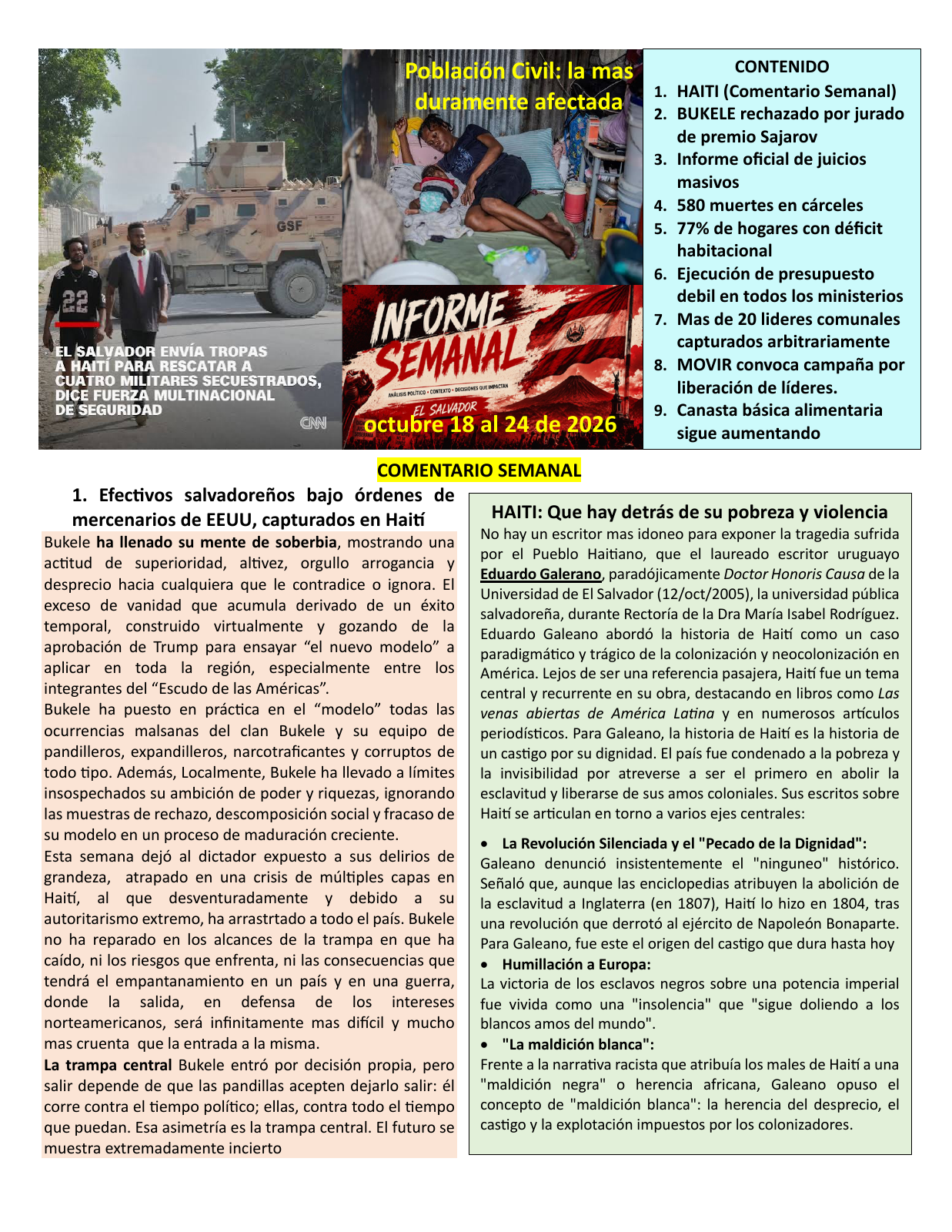
Salvadoran personnel under the orders of US mercenaries captured in Haiti
Bukele has filled his mind with arrogance, displaying superiority, haughtiness, pride and contempt for anyone who contradicts or ignores him. His excessive vanity stems from temporary success, constructed virtually, and from enjoying Trump's approval to test “the new model” to be applied throughout the region, especially among members of the “Shield of the Americas.”
In this “model,” Bukele has put into practice all the pernicious ideas of the Bukele clan and its team of gang members, former gang members, drug traffickers and corrupt figures of every kind. At home, Bukele has also taken his ambition for power and wealth to unsuspected extremes, ignoring the growing signs of rejection, social breakdown and failure of his model.
This week exposed the dictator's delusions of grandeur, caught in a multilayered crisis in Haiti into which, unfortunately and because of his extreme authoritarianism, he has dragged the entire country. Bukele has failed to consider the extent of the trap he has fallen into, the risks he faces, or the consequences of becoming bogged down in a country and a war where getting out, in defense of US interests, will be infinitely more difficult and much bloodier than getting in.
The central trap: Bukele entered of his own accord, but leaving depends on the gangs agreeing to let him leave. He is racing against political time; they are playing for all the time they can gain. That asymmetry is the central trap. The future looks extremely uncertain.
Operational risk: El Salvador does not have unlimited power-projection capacity. Sustaining helicopters, intelligence and logistics in hostile territory entails rotations, casualties and a rescue with little prospect of tactical success. The soldiers were also in a restricted area, calling the mission's protocols into question and raising suspicions of a possible “false flag” operation.
Escalation risk: Bukele opted for direct confrontation, but leaders of the 400 Mawozo gang have publicly challenged him. That confrontation, as in previous operations, will unleash further reprisals against civilians. At the close of this edition, 2,000 SALVADORAN SOLDIERS were leaving for Haiti, which will undoubtedly cause more deaths and injuries.
Strategic risk: The GSF (Gang Suppression Force) operates with 1,563 personnel out of 5,550 authorized and was not designed to rescue hostages. Gangs control 80–90% of Port-au-Prince, the capital, and use kidnapping as their main source of income.
Political and electoral risk: The gangs do not seek a revolution, but to consolidate themselves as de facto political actors. The Viv Ansanm gang has fragmented, and each leader negotiates independently. Captive votes serve as political capital: social control becomes the ability to mobilize or block votes, and every election without dismantling the gangs institutionalizes that power. Haiti has elections in November, and they will take place under fire! The results are unpredictable because of the war and the invasion; it is a war without accountability.
External risk: Erik Prince's Vectus Global, US mercenaries, carried out drone attacks attributed with more than 1,200 deaths, including civilians. The arrangement allows the United States to pay, the UN to legitimize, a private company to fire, and SALVADORAN soldiers and those of other poor countries to assume the risks.
Fiscal risk: El Salvador has a deficit of 4.7% of GDP and debt close to 92% of GDP. A prolonged operation will place much greater strain on public finances.
The question is not whether Bukele will sustain the effort, but whether he has a plan for when the rescue ceases to be a publicity coup and becomes a lengthy negotiation.
Haiti: what lies behind its poverty and violence
No writer is better suited to explaining the tragedy suffered by the Haitian people than the acclaimed Uruguayan writer Eduardo Galeano, who, paradoxically, received an honorary doctorate from the University of El Salvador on October 12, 2005, during Dr. María Isabel Rodríguez's term as rector of the country's public university.
Eduardo Galeano addressed Haiti's history as a paradigmatic and tragic case of colonization and neocolonization in the Americas. Far from a passing reference, Haiti was a central and recurring subject in his work, notably in books such as Open Veins of Latin America and in numerous newspaper articles. For Galeano, Haiti's history is the story of punishment for its dignity. The country was condemned to poverty and invisibility for daring to be the first to abolish slavery and free itself from its colonial masters. His writings on Haiti revolve around several central themes.
The silenced revolution and the “sin of dignity”: Galeano repeatedly denounced the historical erasure. He pointed out that, although encyclopedias attribute the abolition of slavery to England in 1807, Haiti did so in 1804, after a revolution that defeated Napoleon Bonaparte's army. For Galeano, this was the origin of the punishment that continues to this day.
Europe's humiliation: The victory of enslaved Black people over an imperial power was experienced as an “insolence” that “still hurts the white masters of the world.”
“The white curse”: Against the racist narrative attributing Haiti's misfortunes to a “Black curse” or African heritage, Galeano proposed the concept of a “white curse”: the legacy of contempt, punishment and exploitation imposed by colonizers.
From prosperous colony to devastated nation: In Open Veins of Latin America, Galeano describes the wealth of the French colony of Saint-Domingue, based on the brutal exploitation of enslaved labor in sugarcane cultivation. Haiti was a “dumping ground for slaves” generating enormous profits.
After independence, the revolutionaries inherited “a scorched land” and a country devastated by war. Added to this was a suffocating economic burden: France forced Haiti to pay an enormous indemnity of 150 million gold francs, equivalent to billions of dollars today, as “atonement for the sin of freedom.” Haiti finished paying it in 1938. That debt mortgaged its development and made it indebted to US banks, which purchased the debt when France could no longer continue collecting it.
The invisible threat—racism and occupation: Galeano explains how Haiti's example became a “threat” to the slaveholding order. In Brazil, the term “Haitianism” was used disparagingly for disorder and violence because of freedom's “dangerous contagion.” This justified centuries of foreign intervention.
US interference in Haiti: Galeano documented how the United States invaded Haiti in 1915 and occupied it until 1934 to protect City Bank's interests and repeal laws preventing land sales to foreigners. Galeano also criticized the UN's military occupation, asking ironically whom a country that simply wants to exercise its right to dignity could threaten.
A legacy of rebellion and solidarity: Despite the tragedy, Galeano's work on Haiti is also a tribute to its people. He highlights Haiti's solidarity with Latin American independence: in 1816, the country gave Simón Bolívar ships, weapons and soldiers for his struggle, on the sole condition that he free the enslaved.
Against imposed poverty, Galeano vindicates Haitians' creative capacity, their popular art capable of “turning rubbish into beauty.” His work calls on us to see Haiti not only through its misfortunes, but through its heroic history of resistance and unbreakable will for freedom.
Salvadoran soldiers were shopping in a prohibited area
On October 18, 2026, four Salvadoran soldiers from the Gang Suppression Force (GSF) were attacked while shopping in Santo, a community near Croix-des-Bouquets, north of Port-au-Prince, controlled by the Chien Méchant gang, meaning “Vicious Dog.” The 400 Mawozo gang, a criminal group known for widespread kidnappings, also operates there.
Personnel of the United Nations and diplomatic missions are prohibited from entering that area without armored vehicles and weapons. It remains unclear why the Salvadorans were shopping there. At the UN, the United States condemned the attack on Salvadoran soldiers in Haiti and promised: “We will bring them home.”
El Salvador's Armed Forces report a setback in Haiti
The Armed Forces of El Salvador (FAES) reported on October 19, 2026, that the four aviation technicians had been attacked by heavily armed criminal groups. According to the institution, the servicemen managed to escape their armored vehicle after it was hit by explosives and caught fire. FAES also said Salvadoran military helicopters were deployed to support them but came under fire, and other support operations were hindered by violence in the area. The institution said it was working with the gang suppression force to locate its personnel.
Bukele also posted a message on X, translated into Haitian Creole and addressed to the gangs: “Today we launched a military operation to rescue them. We have only one objective: to bring our four compatriots home alive and unharmed.” Bukele said those kidnapped were “not combatants,” but “aviation technicians” taking part in his international mission in Haiti, whose main work is to conduct medical evacuations and save lives, not wage war. He said they were kidnapped “in a cowardly manner” while returning from buying food at a local market. He also urged gang leaders not to take his words as “empty threats.”
On October 21 he warned: “We have already finished off the gangs in El Salvador, and we can finish off yours too.” “I want you gang leaders to understand something very clearly: today's attack is nothing compared with what is coming if you do not release the four hostages alive.” Nevertheless, he left open the possibility of stopping military action if all four were returned unharmed. “We still have time to avoid it. Return our four compatriots alive, without any harm, and everything will go back to how it was before the kidnapping. The decision is in your hands,” he concluded.
On October 22, the Salvadoran government sent a new military contingent to Haiti to assist in the search for four Salvadoran aviation technicians missing since Sunday, October 18, who were reportedly being held hostage by gangs. The GSF confirmed their arrival in Port-au-Prince to support search and security operations in Plaine du Cul-de-Sac, in coordination with Haiti's National Police and operational partners, and asked Santo residents to avoid operational areas. The number of personnel was not specified; the Miami Herald reported, citing sources, that 100 special forces soldiers had been sent and that the form of deployment was still being negotiated. On October 21, the GSF and the Haitian government confirmed operations that left several gang members dead; a high-level meeting also took place at the prime minister's office to evaluate the interventions and strengthen operations.
Prize coveted by Bukele goes to those who condemned him for crimes against humanity
The 2026 Sakharov Prize for Freedom of Thought is the European Parliament's highest award for people, groups or organizations distinguished by their defense of human rights, democracy and fundamental freedoms. The prize was awarded to the International Criminal Court (ICC), according to an announcement by European Parliament President Roberta Metsola on October 22, 2026.
Reasons and merits: The prize recognizes work in defense of human rights and justice.
Finalists: There were three finalists: the International Criminal Court, Tanzanian opposition leader Tundu Lissu, and Iranian activists Taraneh and Romina Rahimi.
The award went to the International Criminal Court for its defense of international law, investigation of serious crimes and judicial independence, particularly in a context of political pressure.
Bukele was nominated by a European far-right group, Europe of Sovereign Nations (ESN), which sought to recognize and promote his security policies, but he was rejected and did not even appear among the finalists.
The Salvadoran dictator's nomination sparked debate, since critics point out that the results were achieved through a prolonged state of exception, mass imprisonment—1.9% of the population deprived of liberty—and allegations of human rights violations that contradict the prize's spirit. More than 80 human rights organizations spoke out against Bukele's nomination.
Attorney General and Security Minister report on mass trials and budget management
Appearing before the Legislative Assembly, Justice and Public Security Minister Gustavo Villatoro presented his ministry's progress and cited the reduction in homicides as one of its main achievements. During his presentation, the official stated: “We want to reaffirm that time has not passed in vain, that we have known how to make use of money and innovation.” With that statement he defended the use of public resources and the incorporation of technological tools in security work. Villatoro also highlighted that the National Civil Police (PNC) has integrated 17 virtual agents performing “digital patrols.” He explained that these agents search in real time for the identities of aggressors using information citizens post on social media.
The measure forms part of efforts to modernize the institution and harness technological innovation in security tasks. Regarding the budget, the minister detailed that in 2024 the Justice and Public Security and National Defense sectors jointly received $866 million. For 2025, the allocation rose to $903.4 million. His appearance before the committee provided an opportunity to present those results and explain the destination of the resources assigned to the security sector.
The official insisted that the achievements, including the reduction in homicides, show that the time and resources invested have been put to use, and that innovation has become a central tool for confronting public security challenges.
Socorro Jurídico reports 580 deaths under the state of exception
Socorro Jurídico Humanitario reported an increase in the number of Salvadorans who have died in state custody during the state of exception, bringing the total to 580. According to the organization, none had been tried and found guilty. It also indicated that more than 94% of the victims did not have a gang-member profile, which it considers evidence of a pattern of arbitrary deaths and impunity within the framework of “mass trials.”
Ingrid Escobar, a lawyer with Socorro Jurídico, said this number of victims has been confirmed over the four and a half years of the state of exception, with the pattern of defendants who have not been convicted continuing. She also said that the patterns of death continue, but many additional deaths result from denial of medical care. The lawyer further stated that executive declarations about releasing imprisoned people stem from pressure and human rights complaints, as well as cases of sick people and deaths in custody that are gaining international attention. Despite these promises, Escobar says such releases are not yet being seen, and a legislative decree at the executive's request is expected at some point to enable these release mechanisms.
FOR NOW, WHAT CONTINUES IS THE DEATHS: the latest report is of four deaths in two days. None had a gang-member profile, none had been convicted, and none had the right to a defense, a hearing or a fair trial. They were presumed guilty from the outset, and the dictatorship killed them.
El Salvador faces a housing deficit affecting a million and a half homes
Using data from the 2024 Census, with support from UNFPA and the Inter-American Development Bank, the Central Reserve Bank (BCR) estimates that 77.2% of Salvadoran households—more than 1.48 million families—face a housing deficit. The total deficit amounts to 1,482,826 homes among the 1,921,357 households counted. The quantitative component, which requires building new homes, reaches 212,473 dwellings, or 11.1%. Since 34,591 homes are available for sale or rent, the minimum new-construction requirement would be 177,882 homes.
The qualitative deficit, requiring improvements, repairs or basic services, affects 1,270,353 households, or 66.1%. Of these, 307,010 live in remediable overcrowding and 387,318 in structures with materials that can be repaired: 150,133 need work on walls, 3,620 on roofs and 233,565 on floors. In addition, 1,074,423 lack water (55.9%), 627,140 lack sanitation facilities (32.7%), 1,167,748 lack wastewater disposal (60.8%), 147,572 lack electricity (7.7%) and 665,275 lack garbage collection (34.6%).
The Nuevo Israel community is a silent witness to the housing deficit affecting A MILLION AND A HALF FAMILIES. BUKELE cut the Housing Ministry's budget; today it is merely a decorative institution.
Poor budget execution
César Villalona; infographic by Radio Izcanal.
The Finance Ministry's report on budget execution through August 2026 reveals that, in the first eight months of the year, nine of the 16 ministries were behind in spending their resources.
The Education Ministry has a budget of $1,768 million, but spent only 58%, or $1,034 million, in eight months. At that rate, it will have executed only 87% of its budget by year-end, or $1,538 million, equivalent to 3.67% of GDP. Some $230 million would remain unspent. The Health Ministry spent only $887 million, equivalent to 58% of the $1,534 million approved. The trend indicates it will execute 87% of its budget and leave $200 million unused.
The Public Works Ministry invested only $451 million, equivalent to 39.6% of the $1,139 million approved. By year-end it will have invested only 60%, leaving $455 million unspent. The Housing Ministry has a $13.6 million budget and had invested $3.3 million, or 24%, by August. Its entire budget is insufficient to build even a hundred low-income homes, and to make matters worse, $9 million, or 66%, will be left over.
Other ministries with low budget execution are Culture, Tourism, Justice and Public Security, Local Development and Environment. Investment in fixed assets—works and construction—is also lagging: only $338 million of a $1,508 million budget has been invested. By the end of the year, $1,000 million will remain uninvested. While these delays persist, the Foreign Affairs Ministry has already spent almost 90% of its budget and will receive additional funds to finish the year.
Finally, the government allocated $1,590 million to DEBT PAYMENTS, but most of it was interest, $996 million. As it continued taking out loans, its debt rose by $1,250 million to $33,150 million, equivalent to 92% of GDP. The government will allocate $2,847 million to debt payments, representing 22% of total spending. Despite the enormous effort to service the debt, it will continue growing rapidly next year. This is because, in addition to loans to cover the deficit, the state will take almost $3,000 million from the pension fund. The financial cost is so high that interest alone—which does not reduce the debt—will total $1,852 million. That exceeds the health budget, set at $1,493 million, which is not fully executed.
102 international organizations demand the release of La Floresta community leaders
For the Bloque de Resistencia y Rebeldía Popular (BRP) and 102 other organizations, the detention of Fidel Zavala and 20 other community leaders is arbitrary. They noted that the case initially concerned fraud, but the offense of unlawful association was later added, and warned that it is being used to criminalize the defense of human rights, according to Francisco Parada.
Marisela Ramírez of the BRP said measures under the state of exception are being applied to those detained, preventing contact to ascertain their health, although their struggle has nothing to do with gangs and they instead face political persecution. The organization demanded their immediate release and joined calls to end the state of exception, which it considers unsustainable and constitutionally weak.
More than 100 international organizations sent a letter to the Attorney General's Office, the Office of the Human Rights Ombudsperson, the Supreme Court of Justice and the Fifth Court against Organized Crime, demanding immediate release and respect for judicial guarantees. Zavala and the leaders were arrested in February 2025 at the La Floresta estate; Zavala was arrested at UNIDEHC's offices.
MOVIR launches a campaign to free people detained under the state of exception
Samuel Ramírez of the Movement of Victims of the Regime (MOVIR) said that, following statements about the release of people detained during the state of exception, they have launched a campaign called “Liberación por los inocentes” (“Freedom for the Innocent”).
Urban basic food basket rises to $269.15 in September
In urban areas, this is its highest cost since 2001, according to the Central Reserve Bank's National Statistics and Census Office (ONEC). It represents an increase of $4.41 compared with August, when it cost $264.74, or 1.7% month over month; and $18.44 compared with September 2025, when it cost $250.71, or 7.4% year over year. The largest absolute increases between August and September were in vegetables, beans, fruit, French bread and fluid milk. The urban basket includes 11 food groups—French bread, tortillas, rice, meat, eggs, milk, fruit, beans, vegetables and sugar—and adds 10% for cooking.
In rural areas, the basket reached $191.04, compared with $189.63 in August, a monthly increase of $1.40, or 0.7%. However, the year-over-year increase was only $0.10, since it cost $190.94 in September 2025. Although this is its highest level in 2026, it remains below the all-time rural high of $193.98 in July 2023. In rural areas, beans recorded the largest increase, followed by fluid milk and eggs.
The rural basket is calculated for 4.26 household members and nine food groups; the urban basket is calculated for 3.73 members.
Rising food prices are among the main concerns. A study by the University of El Salvador's Institute of Economic Research in the second quarter of 2026 found that 96.6% of respondents identified food among the products whose prices had risen and were affecting their purchasing power. In addition, 71.2% of the 354 participants had reduced their spending on basic goods or services in the previous 12 months.
Sources cited in the original report
- https://www.laprensagrafica.com/internacional/soldados-salvadorenos-estaban-de-compras-en-una-zona-restringida-de-haiti-cuando-fueron-atacados-segun-the-new-york-times-20261020-0065.html
- https://www.laprensagrafica.com/liveblogs/soldados-salvadorenos-atacados-en-haiti-lb202610190001.html
- https://t.co/cYLQ0dHrwI
- https://actualidad-rt.com/actualidad/633619-bukele-lanzar-operacion-militar-haiti
- https://www.laprensagrafica.com/elsalvador/el-salvador-envia-mas-tropas-para-busqueda-de-soldados-desaparecidos-en-haiti-20261022-0065.html
- https://x.com/ElTrompudo2022/status/2112937578844303612
- https://elpais.com/internacional/2026-10-22/el-tribunal-penal-internacional-premio-sajarov-2026-del-parlamento-europeo.html?ssm=whatsapp_CC
- https://www.laprensagrafica.com/elsalvador/10561-personas-ya-fueron-condenadas-durante-el-regimen-de-excepcion-segun-datos-de-fiscalia-20261020-0057.html
- https://ysuca.org.sv/2026/10/580-personas-han-fallecido-en-mas-de-cuatro-anos-del-regimen-de-excepcion/
- https://x.com/SJHumanitario/status/1731347630821622101
- https://diario.elmundo.sv/economia/el-77-2-de-los-hogares-salvadorenos-enfrenta-deficit-habitacional-revela-el-bcr
- https://x.com/ElTrompudo2022/status/2112895710743937130
- https://x.com/ysuca91siete/status/2112293031932256744
- https://x.com/ysuca91siete/status/2112942339131900310
- https://www.laprensagrafica.com/economia/canasta-basica-urbana-alcanza-maximo-historico-de-269.15-20261022-0073.html